I haven't written a new post in a very long time due to personal and money issues. I think it's about time for me to return and get my mind off of things.
In times of economic struggle, more people are worrying about money these days. This affects all aspect of one's life, including our pets. Sadly, some people jump the gun and decide to post their dog on Craigslist when they say they can no longer care for them, but they have that new iPhone, flat screen TV, unlimited internet and a sometimes even a new family car. Others really have no alternative. For those of us who are struggling and thinking of ways to keep our pets but cut costs, I bring good news.
Flea and tick preventative
Flea and tick preventatives cost quite a bit of money in the range of $40 - $50 for 3-4 months. What's worse is the chemical ingredients being added to your dog's body. The body utilizes the liver to rid itself of toxins, including those absorbed through the skin. Any potential health problem like this can cost you in cancer treatments or other conditions in the long run, but so can doing without preventative. There is actually a cheaper, yet all natural alternative. It's called Diatomaceous Earth. Food grade diatomaceous earth is used to dust crop plants with when growing organically. It's composition is fossilized diatoms (microscopic algae). These tiny fossils are said to cut like glass on small insects and worms that cross paths with it, killing them. You can purchase Diatomaceous Earth at your local feed store, home improvement store, online and some pet stores. Pet stores that carry this product often have the same thing, only it's labeled for pets, which increases the price dramatically. Try your local feed store. I got 5lbs of it for $13.99 locally, and that container is going to last me a long time. Feed your dog one teaspoon per 10 pounds of weight to rid of worms, or use it as a flea and tick duster all over your pet, even your carpets and yard for flea infestations! After buying this product a while ago and ridding my kitten from tapeworms and fleas, I can say this product actually works well.
Wormer
Diatomaceous Earth - It works well on all kinds of intestinal worms including tapeworms!
Heart worm preventative
The active ingredient for heart worm prevention in dogs is ivermectin. The other chemicals are added for intestinal worms (ex. Pyrantel), which ironically, is something that ivermectin already works to treat. It will not treat tapeworms. There is an injectable cattle and pig product called Ivomec that is around $40 for a 50mL bottle. The bigger the bottle you buy though, the more you save on each dose. At a dose of 0.1mL (cc) per 10 pounds, it's going to last you a long time. Don't inject your dog with it. Give it by mouth or over food. Don't get Ivomec Plus, only regular Ivomec 1% solution. It can be found at Tractor Supply and some other feed stores, and needs stored in the fridge once opened. Use a small syringe to properly measure. A missed decimal point could mean a dead dog. Do not use on ivermectin sensitive dogs like Collies. If you have been giving your dog a product like HeartGuard containing ivermectin without issue, then this is just fine. Many rural veterinarians recommend this method of heartworm prevention. Repeat monthly.
Food
Feeding a healthier diet saves you vet bills in the long run. Most common commercial diets are actually responsible for enough health problems in dogs to write a novel on. Look for something free of grains like corn, wheat and soy, free of food dyes, free of chemical preservatives aside from "mixed tocopherols" (vitamin E), low in carbs and high in meat protein. These foods cost more per bag, but the money on vet bills that you save outweighs savings on cheap food. It's preventative medicine. So is not letting your dog get fat. Check out www.dogfoodanalysis.com for more information. As a rule of thumb, if you can pick it up at the grocery store, it's not worth it, even their new grain free foods which are still mostly plant products. Another tip: buy the biggest bag of the food you selected. The smaller bag might cost less, but it costs more per pound which adds up to you spending more on dog food than you have to.
Treats
Many websites offer recipes for delicious goodies. A recipe free of corn, wheat and soy is best. Or get creative and come up with your own special treat for your dog. Pinterest is full of recipes. My dogs only get their supplements as treats. They love to catch their omega-3 pills in the air after their meal because they taste fishy when they pop them. Don't give your dog too many treats because making him fat is very bad for his health - and your wallet at the vet for his problems later with his joints, heart, and developing conditions. Food is not love. Caring about your dog enough to take care of his health and happiness is love.
Training
Do some research on behavioral issues and training, and train your dog yourself. Training your dog will strengthen his response to you and improve your relationship. Look into NILIF (Nothing In Life Is Free) and other training methods that don't turn you into a walking treat dispenser. Positive reinforcement really does have it's limits for dogs with extreme behavioral problems even though it's the popular thing. If you're experiencing aggression issues with your dog, research into behaviorism rather than ignoring the problem or giving up on the dog.
Toys
If your dog likes toys but you're not too keen on the cost of expensive pet store toys, try making your own at home. A simple pair of socks tied together in a knot will entertain most dogs for quite a while. A lot of dogs also like empty soda bottles for that crackling crunchy feel. If your dog likes tennis balls, order a bag of them online for much less money that are made for humans. Tennis balls made for dogs have high lead content in them anyway, but sports tennis balls have none. If you have a bully breed dog, you may want to buy a Kong extreme toy, or a GoNuts. GoNuts offers free replacement if your dog tears it up to the inner red rubber. The outside is tougher and it comes in 3 shapes. Use Google to find more tough toys. With most bully and mastiff breeds, these toys will last without replacement, which saves money in the long run. Always supervise your dog with toys. No toy is 100% indestructable.
Dog beds
If your dog is in need of a new bed, check out your local home improvement and fabric stores. You can pick up foam padding, then hit the fabric store or Walmart for the fabric, then make it yourself. You can also personalize your dog's bed this way if you wish. If you're not keen on making a bed yourself, check out your local feed store for better prices. Old comforters also do the job, and if you don't have one that you're willing to give to your dog, you can buy one at a thrift store or garage sale. You will need more than one for a heavy dog. If you can still feel the hard floor underneath, add more. Outdor furniture cushions work great, but don't use anything water resistant, stain resistant, or flame retardant as these contain carcinogenic chemicals that your dog will consume when he licks himself or the bed.
Vet
Vet care costs decrease when your dog is fed a species appropriate diet, kept at a lean weight and exercised. Most vets recommend an annual exam, but if your pet is healthy and you don't have the cash, save that money for when your pet does need it. Set aside a percentage of your income for an emergency fund. Chances are your pet will need vet care at some point in the future, and possibly when you least expect it or have less money to cover it. Ask your vet about payment plans. If your pet is sickly, depending on his needs you can look into pet health insurance to cover some of the costs. This will not benefit a healthy pet on a budget however, contrary to marketing plots. Sure, your dog might need it later on, but you can look into those options when they are needed and dig into your emergency fund if you have to. Don't wait until the last minute to take your dog to the vet if something is wrong. Not only could your pet suffer longer, but the expenses will be greater than if the problem was caught early.
Vaccines
Vaccines should never be abused and given every year. A dog's immune system functions the same way a human's immune system does, with a cell memory. Your dog will require a rabies shot by law, and a lot of areas offer the 3 year shot. The 3 year shot saves you money during the course of that 3 years that you would otherwise be paying a percentage of every year (ex. $10 for a 1 year, $15 for a 3 year = $5 a year for a 3 year with a net savings of $15). The other vaccines should be given during puppy-hood or prior to adoption. No more is needed unless you have to board your pet because the facility will ask for proof before allowing your pet to board. Over-vaccination has been linked to cancer and a condition called vaccinosis (and it drains your pocket book for no good reason!)
Grooming
Have a long haired dog, but can't pay the groomer $40 or more for a haircut regularly? Bathe and brush your dog yourself. Invest in dog clippers and learn how to give your dog a haircut yourself. There is plenty of information and tutorials on youtube. If you look into human hair clippers, be aware that although they cost less, they will break down sooner because they aren't meant to cut double coats. A set of dog clippers should last you 5 years if properly maintained. I personally have found that Oster clippers seem to last forever. If you can't spare the money on this, you can get a cheap comb or use one that you already have. Start with the comb at the base of the skin and comb up to the desired length, then cut with scissors along the teeth of the comb at the top where the hair sticks up above it. It's tricky to get an even cut this way and takes much longer, but it's an alternative. If your pet is jumpy, scared or aggressive about grooming, desensitize him to the sensation and be aware that he may have been hurt at the groomer before, even if it wasn't a cut (the pain of ripping out knots can do it). Be gentle but firm.
Exercise
Exercising is beneficial to your dog's health. When paired with a good diet, many vet bills can be avoided and your dog will feel better. This also means your dog will have more energy, but that's a good thing because his metabolism is functioning properly. A tired dog is a happy dog and is less likely to make you buy a new couch from his boredom habits. If you're stressed about money, exercising with your dog is a great way to get rid of some of your stress as well!
Saturday, November 9, 2013

Monday, August 17, 2009
Dog Breed of the Day: Chihuahua
 The smallest dog breed in the world available in 2 convenient sizes: standard and teacup
Introducing the Chihuahua! Thinking of Chihuahuas might conjure up images of tacos and burritos thanks to Taco Bell's past advertising with the famous "Yo querro Taco Bell!" Chihuahua. The Chihuahua originated in Chihuahua, Mexico and is the only dog with questionable ancestry. Did it come from the Grey Wolf like all dogs? Or did it come from the Fennec Fox? There is debate surrounding this theory, and personally, I would like to see a DNA comparison done to officially decide where the Chihuahua really came from.
The Chihuahua is highly portable with it's small body, but don't let this little dog fool you. Chihuahuas can be fierce like little wolves in a teeny tiny body if allowed to be the pack leader. This dog breed often suffers from Small Dog Syndrome, which is a psychological disorder caused by the owners babying the dog and treating it like a human. My advice? A chihuahua is a dog, like any dog including a Rottweiler. You wouldn't want a Rottweiler to behave like a "mean" Chihuahua would you? Then don't let your Chihuahua do it either! Plus, being the pack leader is a big responsibility for your dog and puts added stress on him/her. So your Chi would be happiest if you showed it leadership and peace of mind (as with ALL dogs).
On a lighter note, Chihuahuas are easily smuggled into hotels, grocery stores, and almost anywhere you want to take them. They're also in it for the long haul - 20 years is not uncommon with this breed, so be sure you're willing to take care of a dog for that long. Chihuahuas are also economical and don't need to eat much because they're so small. They're also susceptible to being hurt by rambunctious children, so you probably don't want a Chi if you have toddlers. Walk your Chihuahua often just like you would for any other dog, even though you might think it doesn't need walking because of the small size. I beg you to differ, and behavioral problems will arise if you don't. Playtime is not a substitute for walking. A well balanced Chihuahua is not aggressive and makes a good companion in almost any setting. They do get chilly in the winter, so buy them a little sweater if you live in a region that sees some cold weather. The main point here? Love your Chihuahua as a personal companion, don't baby it, and enjoy years upon years of fun and adventures!
(Image from Wikemedia Commons here: http://en.wikipedia.org/wiki/File:Misterthemodel2.jpg)
Sunday, August 16, 2009
Dog Breed of the Day: German Shepherd Dog
 This is my rescued boy, Titan. He's a German Shepherd Dog (GSD), also sometimes known as the Alsatian. One of the most popular breeds around the globe, the German Shepherd is known for its loyalty, intelligence, trainability, working ability, athleticism and watch/guard dog ability. This is a high energy breed developed for herding, but more commonly seen as police K9 dogs and family protectors/companions. Often sought in serious work fields, the German Shepherd has strong nerves and a sense of purpose. Hardly any breed has such a big difference and controversy in breeding practices in Amercia vs. Germany. Over breeding has produced dogs with an array of health problems. In fact, no other breed has more possible health problems (over 200!) than the German Shepherd. A healthy GSD will give you 12-15 or more years of its life though. Feed this breed at least 2 times a day, never only 1 big meal a day because they are prone to bloat like other large breed deep-chested dogs. Know the symptoms of bloat with any large breed, and how to minimize the risks. Give this breed tons of exercise. If you are a couch potato, this is not the breed for you! The German Shepherd also needs a firm handler to keep dominance under control. The German Shepherd is a large dog, typically weighing in at 75-100 pounds. Keep this dog a little on the lean side to minimize wear and tear on the joints, and most of all, have fun!
Saturday, August 15, 2009
Dog Breed of the Day: American Pit Bull Terrier
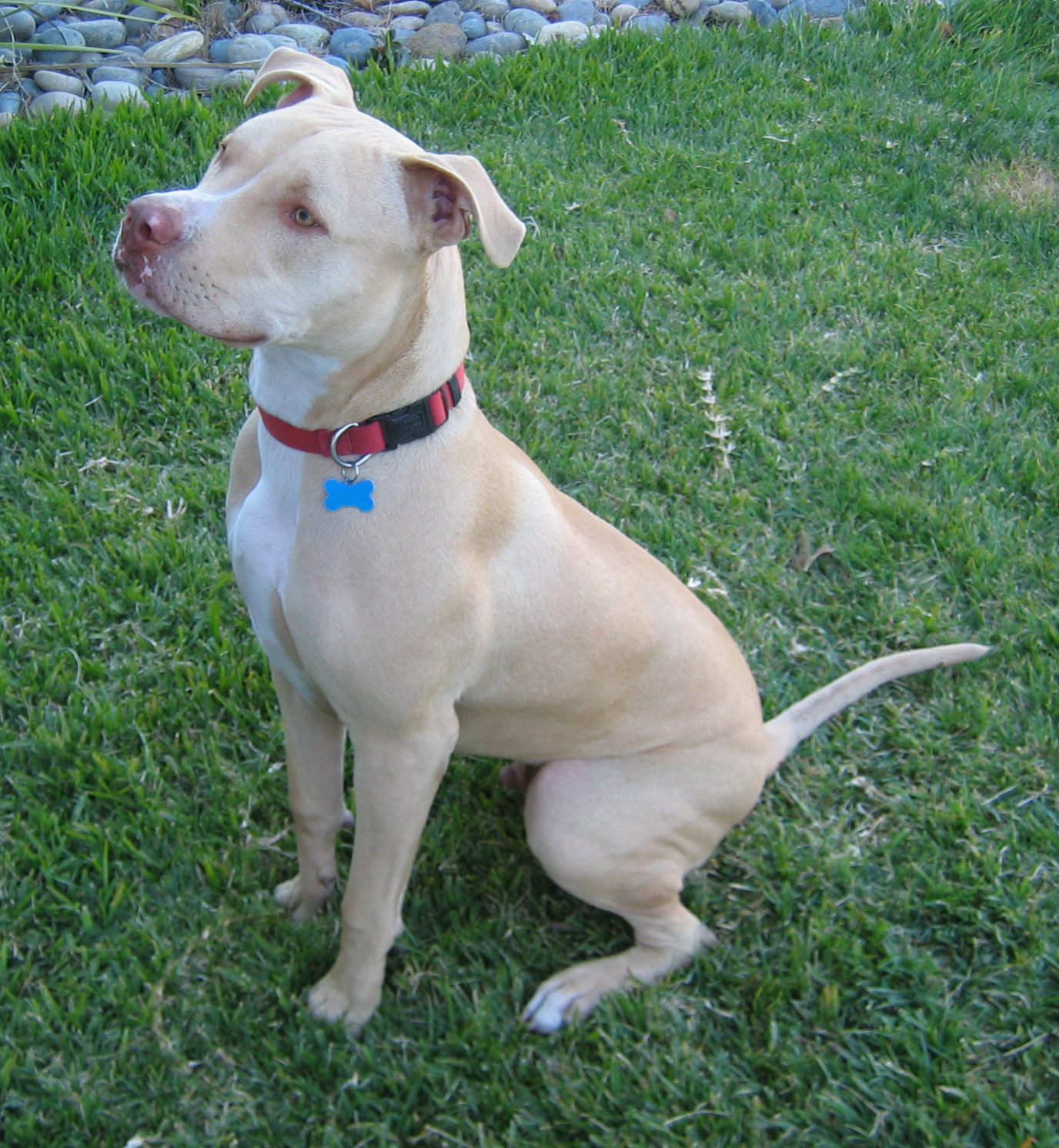 Yes, I love pit bulls. But did you know that there is no such breed as a "pitbull?" The term "pitbull" has become a generic term for a few different breeds with similar characteristics. These often include the American Pit Bull Terrier (APBT), American Staffordshire Terrier (AmStaff), and Staffordshire Bull Terrier (Staffy), and some counties and cities even throw in the American Bulldog, the English Bull Terrier, Cane Corso, Dogue des Bordeaux, Dogo Argentino... and not to mention the popular breed on the rise: The American Bully. I've even read about a town that deemed a Polish Lowland Sheepdog a "pitbull." Look it up and cringe at the stupidity. "Pitbull" legally is whatever your state/county/city decides decides. To the original type American Pit Bull Terrier fancier, the term pit bull can only mean the APBT, which is often simply called a "bulldog." The American Pit Bull Terrier (APBT) and American Bully under the same generic term are targeted the most through the media. Thanks to the bad press it receives accompanied by bad owners, the APBT breed (and the often mislabled American Bully) is currently the most feared. Simultaneously it is one of the most loved breeds of dog in America today. It is also the most bred dog in America, and therefore euthanized in shelters more than any other breed. They are the most difficult breed to find a good home for. Ignorance and fear have caused breed specific legislation (BSL) to spread and convince people that these people-loving dogs are out to get them. What most people don't understand though, is that there is a BIG difference between dog-dog aggression (DA) and human aggression (HA) in the APBT. The APBT was actually selectively bred to have an exceptionally stable temperament towards humans due to its fighting history. Dogmen had to be able to pull dogs apart in the pit during a fight with out redirected aggression. A lot of myths surround this mystic breed, but I'll do more articles on that later.
The APBT loves human attention, play time and has all the energy and determination of a true working dog. They are one of the best working dogs for most sports and jobs because they love to please and are very athletic. Their clownish behavior and fun loving, yet determined personality makes them a breed to love. They are not for everyone though. As with any breed, do your homework EXTENSIVELY before bringing home a dog that you might find yourself unable to handle. In the right hands, an APBT melts like butter and will love you for life. There is nothing like a pittie smile and pittie kisses all over your face! They love to cuddle. Many people find these lovable qualities endearing, so they blindly breed dogs left and right. This reduces the qualities it was originally bred for and threatens the breed. There is nothing wrong with pit bulls at all. What is wrong is most of the people who own them. Their tough image is attracting the wrong kind of people, and the media is to blame for sensationalizing them, even outright lying about them. I recommend reading an ebook that can be found for free called The Pitbull Placebo to understand why pit bulls are demonized in society.
(Image reproduced from Wikemedia Commons here: http://en.wikipedia.org/wiki/File:American_Pit_Bull_Terrier_-_Seated.jpg)
Saturday, August 8, 2009
What to look for in a good veterinarian
Earlier I told you I would show you how to pick a good veterinarian. No amount research on a particular vet can totally prepare you for what to expect, or even show you that he/she is a good doctor. You just have to see for yourself!
How much does it cost per office visit?
Does he/she have emergency hours? If so, when are they?
How long has he/she been in practice?
Directions (if needed)
Then, if you have set up a time to meet with the vet, drive out there to see the office. (Please keep in mind that it may be difficult to set up a time to meet the vet without an appointment for your pet because they are often very busy.) Now you can assess the office. Is it old, run down and operating from a trailer? Is it big, fancy and expensive? Of course, there are always exceptions, but generally a good vet will have an office somewhere in between - not big and expensive, and not run down in a trailer. A run down place could indicate a lack of funds - and customers, which could point to a lack of quality (remember, this is not ALWAYS the case). A big expensive office could indicate price gouging or overcharging... maybe even pressuring customers into buying products they don't need. Also, is the office busy or empty? A good vet is probably has some customer activity going on, but it shouldn't be so busy that you wouldn't get enough one on one time.
When you meet the vet, assess how he/she treats you. He/she should make sufficient eye contact with you, and you should feel comfortable in his/her presence (for a first meeting). Ask questions about policies, and routine treatments. Does the vet recommend that your dog get vaccinations every year? If so, why? Tell him/her you don't want to over-vaccinate your pet, and see what the response is. Does the vet want to leave the conversation, get irritated or make you feel belittled? If so, move on! (I'll tell you more about annual vaccines and why they actually harm your dog later.) If he/she seems open or accepting of this idea, ask about nutrition. Does he/she recommend a certain brand of dog food? If so, ask why. How accepting is the vet of your decision to feed something else, preferably something high in protein and grain-free, or even raw? If your vet highly recommends not feeding high protein, grain-free, or raw meat, move on! Your vet should be at least open about these things. I will also discuss nutrition later, and why sadly a lot of vets recommend the worst food you could possibly give your dog.
Something else that may or may not concern you is your preference for obtaining monthly preventatives for heart worms, fleas and ticks. Do you like to order it online rather than pick it up at the vet's office? If so, ask about this policy. To order heart worm preventative, you have to have a prescription from your vet, and not all vets are willing to do this. Some will only let you get it by picking it up at the office (more money in their pockets). If this is an issue with you, discuss it. If you like to order online because it costs less, ask if he/she will match the price for you. If you found a reputable site with a lower price like Drs Foster and Smith, or 1-800 Pet Meds (although I find this one to cost the same as what most vets charge anyway), and the vet won't match it... You do the math. This is only a matter of personal preference and is far less important than where your vet stands on important topics relavent to your dog's health, and the ability for you to relate to each other in conversation and exchange of helpful information regarding your pet.
You don't want to underestimate the power of the vet tech in deciding upon your vet. Vets usually pick techs that match them... So if the tech(s) is friendly, outgoing and very willing to help you, chances are the vet they work for probably is to. If the tech(s) is cold, quiet, distant, rude or demeaning, the vet probably is to!
Also look at the office. Is it clean, organized and decorated to increase the appearance of a friendly environment? This is a plus! You might want to stay away from unorganized offices and exam rooms - If the staff (and thus, the vet) are too busy to make a presentable enviroment that's more welcoming than cold, you might have less one on one time to your vet. This one on one time I keep mentioning is important. Your vet must have adequate time for you and your pet in order to know you both better. This is for the sake of your pet! The more he/she knows about your pet's history, normal behavior, interactions, etc, the better.
If you decide you might have found the right vet, bring in your pet for an appointment. When you come in, you can assess how your pet is treated. Does the vet seem friendly and pet your animal to establish a friendly relashionship? A friendly relationship is important for pets too! Or does he/she look down upon the animal, refer to it as "the dog" rather its name? If you went through the steps above, the vet probably responds well to your pet. If the vet doesn't, and is instead impersonal with your pet, it's time to move on. You really want a vet who is compassionate about what they do, and cares about your pet.
A note on Banfield - inside PetSmart. You might think I would not recommend this practice, but actually I recommend going through the same procedure I listed above. As with any practice, there are good ones and bad ones, and that includes Banfield. I've heard both great stories and horror stories - again, as with any practice.
Find what works for YOU, and happy hunting!
- Look up vets in your area (or how ever far you're willing to go).
- Ask any friends/family who live near you about vets they go to - this might give you a starting point.
- Call the offices to ask questions. You may even want to make a list of things you want to ask.
- If you like the answers to the questions, set up a time that you can meet with the vet.
- Meet the vet, observes how he/she treats you, and ask more questions!
How much does it cost per office visit?
Does he/she have emergency hours? If so, when are they?
How long has he/she been in practice?
Directions (if needed)
Then, if you have set up a time to meet with the vet, drive out there to see the office. (Please keep in mind that it may be difficult to set up a time to meet the vet without an appointment for your pet because they are often very busy.) Now you can assess the office. Is it old, run down and operating from a trailer? Is it big, fancy and expensive? Of course, there are always exceptions, but generally a good vet will have an office somewhere in between - not big and expensive, and not run down in a trailer. A run down place could indicate a lack of funds - and customers, which could point to a lack of quality (remember, this is not ALWAYS the case). A big expensive office could indicate price gouging or overcharging... maybe even pressuring customers into buying products they don't need. Also, is the office busy or empty? A good vet is probably has some customer activity going on, but it shouldn't be so busy that you wouldn't get enough one on one time.
When you meet the vet, assess how he/she treats you. He/she should make sufficient eye contact with you, and you should feel comfortable in his/her presence (for a first meeting). Ask questions about policies, and routine treatments. Does the vet recommend that your dog get vaccinations every year? If so, why? Tell him/her you don't want to over-vaccinate your pet, and see what the response is. Does the vet want to leave the conversation, get irritated or make you feel belittled? If so, move on! (I'll tell you more about annual vaccines and why they actually harm your dog later.) If he/she seems open or accepting of this idea, ask about nutrition. Does he/she recommend a certain brand of dog food? If so, ask why. How accepting is the vet of your decision to feed something else, preferably something high in protein and grain-free, or even raw? If your vet highly recommends not feeding high protein, grain-free, or raw meat, move on! Your vet should be at least open about these things. I will also discuss nutrition later, and why sadly a lot of vets recommend the worst food you could possibly give your dog.
Something else that may or may not concern you is your preference for obtaining monthly preventatives for heart worms, fleas and ticks. Do you like to order it online rather than pick it up at the vet's office? If so, ask about this policy. To order heart worm preventative, you have to have a prescription from your vet, and not all vets are willing to do this. Some will only let you get it by picking it up at the office (more money in their pockets). If this is an issue with you, discuss it. If you like to order online because it costs less, ask if he/she will match the price for you. If you found a reputable site with a lower price like Drs Foster and Smith, or 1-800 Pet Meds (although I find this one to cost the same as what most vets charge anyway), and the vet won't match it... You do the math. This is only a matter of personal preference and is far less important than where your vet stands on important topics relavent to your dog's health, and the ability for you to relate to each other in conversation and exchange of helpful information regarding your pet.
You don't want to underestimate the power of the vet tech in deciding upon your vet. Vets usually pick techs that match them... So if the tech(s) is friendly, outgoing and very willing to help you, chances are the vet they work for probably is to. If the tech(s) is cold, quiet, distant, rude or demeaning, the vet probably is to!
Also look at the office. Is it clean, organized and decorated to increase the appearance of a friendly environment? This is a plus! You might want to stay away from unorganized offices and exam rooms - If the staff (and thus, the vet) are too busy to make a presentable enviroment that's more welcoming than cold, you might have less one on one time to your vet. This one on one time I keep mentioning is important. Your vet must have adequate time for you and your pet in order to know you both better. This is for the sake of your pet! The more he/she knows about your pet's history, normal behavior, interactions, etc, the better.
If you decide you might have found the right vet, bring in your pet for an appointment. When you come in, you can assess how your pet is treated. Does the vet seem friendly and pet your animal to establish a friendly relashionship? A friendly relationship is important for pets too! Or does he/she look down upon the animal, refer to it as "the dog" rather its name? If you went through the steps above, the vet probably responds well to your pet. If the vet doesn't, and is instead impersonal with your pet, it's time to move on. You really want a vet who is compassionate about what they do, and cares about your pet.
A note on Banfield - inside PetSmart. You might think I would not recommend this practice, but actually I recommend going through the same procedure I listed above. As with any practice, there are good ones and bad ones, and that includes Banfield. I've heard both great stories and horror stories - again, as with any practice.
Find what works for YOU, and happy hunting!
Thursday, August 6, 2009
Exercise - The basic remedy for health
One of the most basic things you can do for your dog is give him/her plenty of exercise! This is truly a must, especially if you have a high energy breed. No more lounging on the couch munching popcorn with your dog - Get out there and get fit! Your dog will love you for it, and you will benefit too! There are many ways to exercise your dog, and a few things to keep in mind concerning age, breed, and any health problems your dog may have. The benefits from exercise are boundless for both you and your dog, so let's find a few ways to make it interesting!
Here are some exercises you can do with your dog:
Why is exercise so important? You may be thinking... "My dog just sits around all day and doesn't have any behavioral problems! Why should I push him/her more?" That may be the case, but most healthy dogs don't lounge around all day. All dogs have the instinct to migrate with the pack. You happen to be a part of your dog's pack and have a responsibility to fulfill your dog's needs.
Exercise is good for the heart, muscles, and mind. It builds lean muscle mass, keeps the heart in shape, burns fat, maintains lung capacity, increases stamina and overall health including an improved ability to make it through medical conditions. Think about it: A dog with a weak heart probably has a smaller chance of surviving a traumatic event than a dog with a strong heart in peak condition. The better shape your dog is in, the better chance you're in it for the long haul (combined with excellent nutrition)!
Here are some exercises you can do with your dog:
- walking
- running
- biking
- hiking
- jogging
- swimming
- fetching
- playtime with other dogs
- tug-o-war
- Frisbee
- weight pull (yes, ANY breed can do it!!)
- agility
- long jumping
- schutzhund
- backpacking (having your dog wear a backpack while on walks)
- tracking
- herding
- flyball
- cart pulling
- flirt pole
- spring pole
- racket
- obedience
Why is exercise so important? You may be thinking... "My dog just sits around all day and doesn't have any behavioral problems! Why should I push him/her more?" That may be the case, but most healthy dogs don't lounge around all day. All dogs have the instinct to migrate with the pack. You happen to be a part of your dog's pack and have a responsibility to fulfill your dog's needs.
Exercise is good for the heart, muscles, and mind. It builds lean muscle mass, keeps the heart in shape, burns fat, maintains lung capacity, increases stamina and overall health including an improved ability to make it through medical conditions. Think about it: A dog with a weak heart probably has a smaller chance of surviving a traumatic event than a dog with a strong heart in peak condition. The better shape your dog is in, the better chance you're in it for the long haul (combined with excellent nutrition)!
Happy, healthy dog!
So you want your dog to be happy and healthy? Congratulations! Join the millions of dog owners around the world who care about their dogs like family and wish the best for them. You may be surprised at a few things though. Dogs are a large responsibility, and what is so sad is how you can't trust just anyone to the well being of your pet! Sometimes you need to do a little research for yourself to make a truly informed decision, and listen to yourself for what is best for your companion and you. You are your dog's world, his leader, the object of his affection and his provider.
In this blog, I'll help you know how to pick a good vet, and let you in on some inside secrets your vet probably hasn't told you concerning nutrition and vaccinations (in some cases, particularly in nutrition, vets may even be unaware of proper nutrition because nutritional courses are only optional! This is alarming, but I'll explain that later).
Times are changing and so is our knowledge of man's best friend, along with the products companies manufacture to accommodate them! But do we really need a ton of fancy equipment? Not unless you just want to spoil your dog or do serious sporting events, conformational showing or other hobbies. Back in the day, the family farm dog lived longer than today's pampered pooch with nothing but a collar (if that!), table scraps, a place to sleep and leadership from the family. Then what is so different nowadays? Most commercial food, over-vaccinating, over-breeding, substandard breeding, long work schedules and alone time, or stressful living by being chained or simply being overtaken by behavioral problems due to lack of exercise have all contributed to trouble adapting in today's society. But with a little reading, I can tell you how to solve those problems, or better yet, prevent them!
I'll also discuss health problems that are both common and not-so-common, along with some temporary remedies you can do at home for your pet. If you've made a commitment to the life of your dog, whether he/she lives only for 6 years or for 20+ years, then you're ready to obtain all the information you can to insure your pet is happy and healthy for the years to come. Whether your pet is healthy and you just want to learn more and take precautions, or if he/she suffers from chronic illness or pain, I'll cover topics A to Z! If there is something specific you want me to cover, just put that in the comments section.
In this blog, I'll help you know how to pick a good vet, and let you in on some inside secrets your vet probably hasn't told you concerning nutrition and vaccinations (in some cases, particularly in nutrition, vets may even be unaware of proper nutrition because nutritional courses are only optional! This is alarming, but I'll explain that later).
Times are changing and so is our knowledge of man's best friend, along with the products companies manufacture to accommodate them! But do we really need a ton of fancy equipment? Not unless you just want to spoil your dog or do serious sporting events, conformational showing or other hobbies. Back in the day, the family farm dog lived longer than today's pampered pooch with nothing but a collar (if that!), table scraps, a place to sleep and leadership from the family. Then what is so different nowadays? Most commercial food, over-vaccinating, over-breeding, substandard breeding, long work schedules and alone time, or stressful living by being chained or simply being overtaken by behavioral problems due to lack of exercise have all contributed to trouble adapting in today's society. But with a little reading, I can tell you how to solve those problems, or better yet, prevent them!
I'll also discuss health problems that are both common and not-so-common, along with some temporary remedies you can do at home for your pet. If you've made a commitment to the life of your dog, whether he/she lives only for 6 years or for 20+ years, then you're ready to obtain all the information you can to insure your pet is happy and healthy for the years to come. Whether your pet is healthy and you just want to learn more and take precautions, or if he/she suffers from chronic illness or pain, I'll cover topics A to Z! If there is something specific you want me to cover, just put that in the comments section.
Subscribe to:
Comments (Atom)

